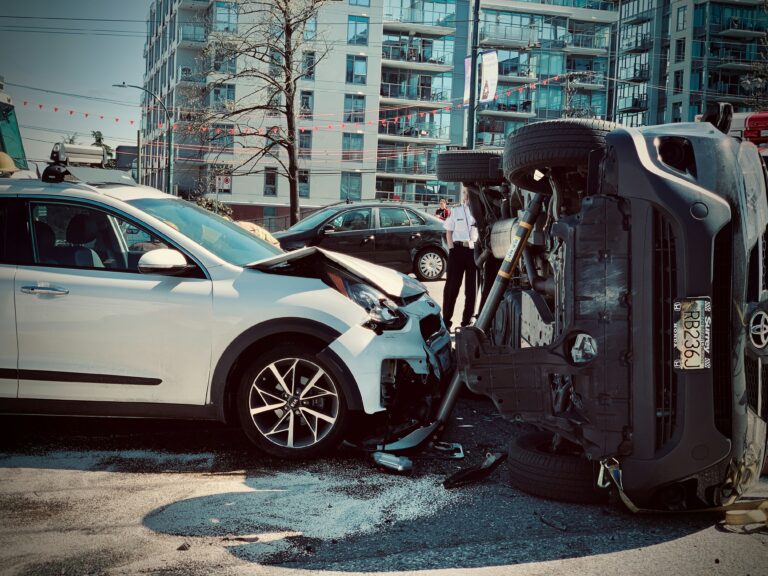

Being partly at fault for an accident does not automatically end your injury claim in Georgia. Georgia follows modified comparative negligence: your damages are reduced by your percentage of fault, and you can recover as long as you are less than 50% at fault. At 50% or more, you recover nothing (O.C.G.A. § 51-12-33).
That cutoff is why fault percentages matter so much. A few points can be the difference between a reduced award and no award at all, and the other side may work hard to push your share up.
Key Takeaways
- Georgia uses modified comparative negligence with a 50% bar, not pure comparative negligence.
- Your recovery is reduced by your share of fault. At 49% you can still recover; at 50% you cannot.
- Fault is argued by adjusters in settlement talks and decided by the jury at trial.
- Georgia divides fault among everyone who caused the harm, and each defendant generally pays only its own share.
- Since Georgia’s 2025 tort reform, evidence that you were not wearing a seat belt may be admitted on fault and causation.
What Comparative Negligence Means
Comparative negligence, also called comparative fault, is the rule for accidents where more than one person was careless. Instead of treating fault as all or nothing, a jury or an insurance adjuster assigns each person a percentage of responsibility, and your recovery goes down by your percentage.
Georgia is not a pure comparative negligence state. In pure states you can recover even if you were 99% at fault. In Georgia, the cutoff is 50%. Our legal glossary explains related terms such as apportionment of fault.
How the 50% Rule Changes What You Recover
| Your share of fault | Total damages | What you can recover |
|---|---|---|
| 0% | $100,000 | $100,000 |
| 20% | $100,000 | $80,000 |
| 49% | $100,000 | $51,000 |
| 50% | $100,000 | $0 |
| 60% | $100,000 | $0 |
These figures only illustrate the math. They are not a prediction of what any case is worth.
How Fault Is Decided
- In settlement talks, the adjuster assesses fault, and each side argues about it.
- At trial, the jury decides each party’s percentage.
- More than one at-fault party: Georgia divides responsibility among everyone who caused the harm, and each defendant generally pays only its own share. Fault can even be assigned to someone who is not in the lawsuit if the defense gives proper notice (O.C.G.A. § 51-12-33).
- Seat belts: under Georgia’s 2025 tort reform law (SB 68), evidence that you were not wearing a seat belt may now be admitted on negligence, comparative negligence, causation and apportionment of fault, and may reduce a recovery (O.C.G.A. § 40-8-76.1). A judge can still exclude it in some circumstances.
The evidence that decides fault includes police reports, photos and video, vehicle damage, witness statements, phone records, and expert crash reconstruction or medical causation opinions. Our guide to Georgia crash report codes explains how to read the officer’s findings.
Examples by Type of Case
- Car accident: you were going 10 over the limit when another driver ran a red light and hit you. The jury finds the other driver 70% at fault and you 30%. Damages of $50,000 become $35,000.
- Rear-end crash: you rear-end a car that stopped suddenly, and the jury finds you 55% at fault for following too closely. At 55% you recover nothing. Rear-end fault is not always one-sided; see our guide to Georgia rear-end accidents.
- Slip and fall: a store left a spill on the floor, but video shows you were looking at your phone. You are found 25% at fault, so $20,000 in damages becomes $15,000.
- Pedestrian: a pedestrian crossing mid-block is hit by a speeding driver. With 40% fault on the pedestrian, $100,000 in damages becomes $60,000.
- Defective product: a manufacturer claims you misused a machine. If you are found 30% at fault, your award is reduced by 30%.
- Workplace injury: workers’ compensation is a no-fault system, so your own fault generally does not reduce comp benefits. Comparative fault can apply to a separate claim against a third party, such as an equipment maker.
All of these examples are hypothetical.
How Insurance Companies Use Comparative Fault
Adjusters may use shared fault to lower an offer or deny a claim. Watch for:
- Blaming you for being distracted, even without proof
- Arguing you could have avoided the crash
- Taking a recorded statement and using your words against you
- Leaning on vague evidence to push your share toward 50%
Our article on insurance lowball tactics covers other approaches to watch for.
What to Do If You Are Accused of Partial Fault
- Do not admit fault at the scene, to the other driver’s insurer or on social media.
- Gather evidence now: photos, witness names, and requests for store or traffic camera video before it is erased.
- Get the police report and ask about correcting factual errors.
- Get medical care right away so your injuries are documented and tied to the accident.
- Talk to a Georgia injury lawyer before giving a recorded statement.
If you were hurt in a crash, our car accident page explains more about Georgia claims.
Frequently Asked Questions
Can I Recover Damages If I Was 50% at Fault in Georgia?
No. Under O.C.G.A. § 51-12-33 you must be less than 50% at fault to recover. At exactly 50%, you recover nothing.
What If I Was 49% at Fault?
You can still recover, but your damages are reduced by 49%. A $100,000 award would become $51,000.
Who Decides How Much Fault I Have?
In settlement negotiations the insurance adjuster makes an assessment and each side argues about it. If the case goes to trial, the jury decides each party’s percentage based on the evidence.
Does Partial Fault Affect a Workers’ Compensation Claim?
Generally no. Workers’ compensation does not reduce benefits for ordinary carelessness on your part. Comparative fault can still reduce a separate injury claim against a third party.
Being partly at fault does not automatically end your claim, but every percentage point matters. Talk with The Gunn Law Group about how fault may be divided in your case. The consultation is free and there is no obligation, and there is no attorney fee unless we recover for you. Call 888-BIG-GUNN (888-244-4866). Hablamos español.