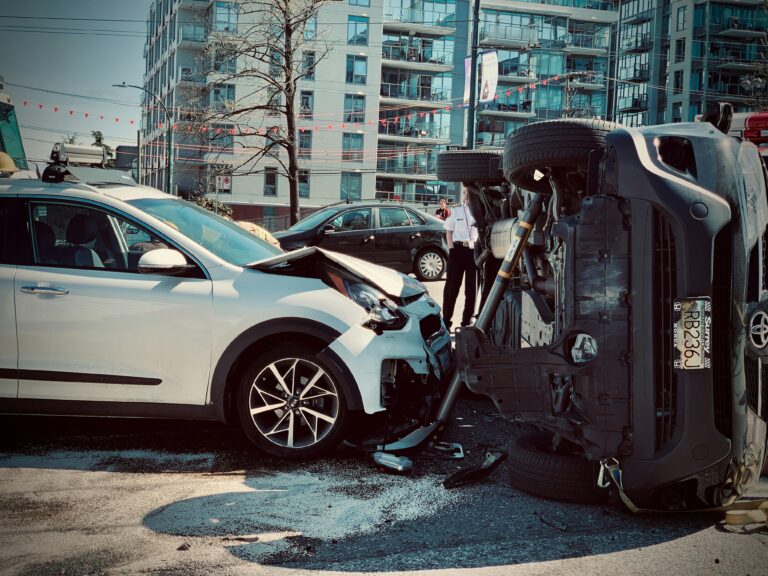
If you were hurt in a Georgia intersection crash, expect the other driver to say they had the green light too. Intersection wrecks quickly turn into a “he said, she said” fight, and that uncertainty gives insurers room to delay, deny or argue that you share the blame.
The good news is that intersection cases can be proven. Video, witnesses, the police report and the physical evidence often show who had the right of way. The key is acting quickly to preserve that evidence before it disappears.
Key Takeaways
- Under Georgia law, a steady red light means stop, a yellow light warns that red is coming, and a driver turning on a green light must yield to oncoming traffic (O.C.G.A. § 40-6-21).
- A driver turning left must yield to oncoming vehicles that are close enough to be an immediate hazard (O.C.G.A. § 40-6-71).
- Traffic and business camera footage is often the strongest proof of the light phase, and it may be recorded over within days.
- Under Georgia’s 50 percent rule, insurers have a financial reason to argue you share the fault.
- Don’t guess about the light or your speed in statements; stick to what you know.
Why Intersection Crashes Become Disputed
In many intersection wrecks, both drivers swear they had the right of way. Drivers also say things at the scene like “I didn’t see them” or “I thought I could make it,” which insurers later treat as admissions. Intersection impacts are often hard and fast, so injuries can be serious, but when fault is disputed the insurer may try to underpay even when your medical damages are clear.
Common intersection scenarios include:
- Red-light running
- Left-turn drivers failing to yield
- Yellow-light timing disputes
- Confusion at unprotected turns
- Views blocked by trucks or other traffic
- Speeding through a “stale” green
- Several cars moving at once
What Georgia Law Says About Signals and Right of Way
Georgia’s traffic signal statute, O.C.G.A. § 40-6-21, sets the basic rules:
- Green: You may proceed, but drivers turning on a green light must yield the right of way to approaching vehicles.
- Steady yellow: A warning that the green movement is ending and a red light will follow.
- Steady red: You must stop at the marked stop line or, if there isn’t one, before the crosswalk or intersection.
Left turns have an added rule. Under O.C.G.A. § 40-6-71, a driver turning left within an intersection, or into an alley, private road or driveway, must yield to any vehicle coming from the opposite direction that is in the intersection or close enough to be an immediate hazard.
These rules are the starting point, but fault is decided on the evidence. That’s why proof of the light phase and timing matters so much.
How Fault Is Proven in Georgia Intersection Claims
Proving an intersection case means showing who had the right of way and when. Common evidence includes:
- Traffic camera or nearby business footage
- Dashcam video from any vehicle involved
- Independent witnesses who saw the light
- The police report and crash diagram
- Vehicle damage showing the angle of impact
- Event data from the vehicles in some cases
- Photos of signal placement, lane arrows and sight lines
Even without an official traffic camera, gas stations, stores and parking decks often have cameras pointed at the intersection. Check the police report carefully; our guide to Georgia crash report codes explains what the officer’s codes mean.
Left-Turn Crashes Deserve Special Attention
Left-turn collisions are among the most common serious intersection crashes. The turning driver usually has a duty to yield, but insurers still argue exceptions, such as:
- The oncoming driver was speeding
- The oncoming driver ran a yellow or red light
- The turning driver had a protected green arrow
- The view was blocked and the timing was unclear
Because these cases often come down to seconds, video and witness proof is critical.
Why Georgia’s 50 Percent Rule Matters
Georgia follows a modified comparative fault rule (O.C.G.A. § 51-12-33). If you are found 50 percent or more responsible, you recover nothing, and a smaller share reduces your award. In intersection cases, insurers may argue you were speeding, didn’t brake, should have yielded or entered on a late yellow. Clear evidence keeps your share of blame from being inflated. Our guide to insurance lowball tactics explains more ways adjusters try to reduce claims.
Steps to Take Right Now to Protect Your Claim
- Get medical care and follow the treatment plan. Consistent records connect your injuries to the crash.
- Take wide photos and video of the intersection, including signals, lane arrows, signs and sight lines.
- Get witness names and phone numbers. Neutral witnesses can confirm the light and each car’s direction.
- Ask nearby businesses about cameras right away. Footage may be overwritten within days.
- Be careful with recorded statements. Adjusters may try to lock you into details about timing and speed.
- Don’t guess about the light phase. Guesses create inconsistencies insurers can use.
- Check the police report for errors in lane diagrams or missing witness information.
- Talk to a lawyer early so preservation letters go out before evidence is lost.
Frequently Asked Questions
Who Is at Fault in a Left-Turn Accident in Georgia?
Usually the turning driver, because Georgia law requires a driver turning left to yield to oncoming vehicles that are close enough to be an immediate hazard. But it isn’t automatic. If the oncoming driver ran a red light or was speeding badly, fault can shift or be shared.
Is It Illegal to Go Through a Yellow Light in Georgia?
Under O.C.G.A. § 40-6-21, a steady yellow is a warning that the light is about to turn red, while a steady red requires you to stop. Whether entering on yellow was careless depends on the timing, speed and distance involved, which is why video and witnesses matter.
What If Both Drivers Say They Had the Green Light?
Then the case turns on independent evidence: camera footage, neutral witnesses, damage patterns, vehicle data and the intersection’s signal timing. The sooner that evidence is preserved, the better your chance of proving what happened.
Can I Still Recover If I Was Partly at Fault?
Yes, as long as you are less than 50 percent at fault, but your recovery is reduced by your share. Most Georgia injury claims must also be filed within two years (O.C.G.A. § 9-3-33); see our guide to Georgia personal injury deadlines.
If you were hurt in a Georgia intersection crash and the insurer is trying to blame you too, focus on your health and let us handle the fight. Learn more about our car accident cases. Consultations are free and no-obligation, and there is no fee unless we win. Call 888-BIG-GUNN (888-244-4866).